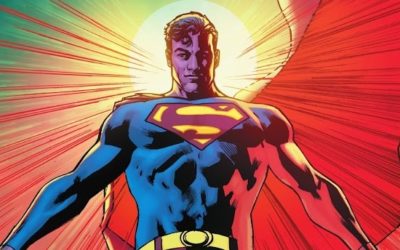

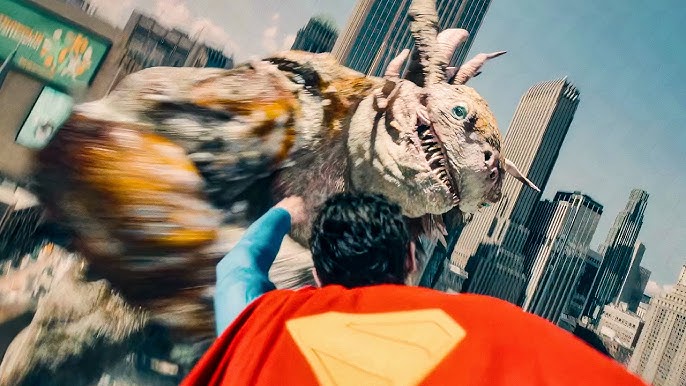
Like a lot of Superman fans, big and little, I got some kind of goosebumps when the trailer first dropped — but there was one scene that did me in. You know the one: Superman fighting the Kaiju.
Superman (2025) trailer © DC Studios / Warner Bros. Used under fair use.
So cool. Superman fighting a giant monster.
But a stupid voice in my head reminded me — we don’t have giant monsters in our world.
Sometimes the little kid in me shakes his fist at the universe.
The reasons why are locked in stone, as far as life as we know it on earth, and it all boils down to something called the cube-square law.
Friggin’ Laws.
As far as physics and biology go, the cube-square law is pretty straightforward: if you make an animal larger, the surface area increases by the square of the growth factor, while the volume (and mass) increases by the cube of that factor.
For instance, say you want to double (2x) the size of your pet dog. Your dog weighs 10 kg.
Your new, larger pet’s surface area would be about 4 times (2² = 4) its original size, while its mass (volume) would be 8 times (2³ = 8) more.
So far, so good. That’s just the physics – a square vs. a cube.
Now, let’s bring in some more physics and some biology.
You’re Gonna Need Thicc Legs
As everything has been getting bigger on your dog, we start to run into real problems with their legs.
Bigger muscles (to move the bigger animal) have more strength, sure, but that strength is related to the cross-sectional area (think the area of a circle, A = πr²) of the muscles and bones. Again, the mass increases by the cube, but the strength of the muscle and the bones (together = “leg strength”) increases by the square of the cross-sectional area.
It’s why elephants have uniform, thick legs.
But we’re not talking about elephants, we’re talking about your 10 kg dog. Let’s give them legs that are 2 cm in diameter (so a radius of 1 cm). Ready for some math? So am I!
Cross-sectional area of the leg:
A = πr²
A = π(1)²
A = 3.14 cm²
Your dog has a mass of 10 kg, so each leg is supporting one-quarter of that mass, in other words, 2.5 kg per leg. Per square cm, then —
2.5 kg/3.13 cm² = 0.79 kg/cm².
That’s the ratio that works for this dog, given its normal, doggy dimensions. Goof that ratio up, and things won’t work. It must be 0.79 kg/cm². That’s the stress it can handle, per leg. Yeah, dogs walking on two legs might be cool to see on TikTok, but they can’t do it for long, given this and other structural reasons (they’re not built that way).
Okay, so let’s double that dog’s size (and cube its mass).
New mass = 80 kg (10 kg x 8)
Now, each leg has to support 80/4 = 20 kg. Will that work?
Spoilers – no.
Scale up the leg size, doubling all its dimensions, making it twice as tall and twice as thick, with legs that are twice the diameter of the original. They were 2 cm, so now they’re 4 cm; therefore, our new radius is 2 cm. Running that through the same calculation as above:
A = πr²
A = 12.57 cm²
Each leg now supports 80/4 = 20 kg.
Our original ratio (for our normal-sized pup) was 0.79 kg/cm2. That’s what works for the proportions of the animal, large or small. When we run through the mass/area ratio after doubling…
20 kg/12.57 cm² = 1.59 kg/cm².
No bueno. Given the dog’s proportions, it can only handle 0.79 kg/cm². We need to pull that ratio down by making those legs thicc. How much thicker?
Well, algebra:
We divided the mass by the cross-sectional area to get the stress load. Let’s just rearrange:
mass/area = stress load.
How about —
mass/stress load = area
20 kg/0.79 kg/cm² = 25.32 cm².
That’s the area, so pull that back to get our radius from:
A = πr²
25.32 cm² = πr²
25.32/π = r²
r = 2.84 cm
diameter = 2 x radius = 5.7 cm.
Compare that to our original leg diameter (2 cm) at our original mass (10 kg). To stand up, our double dog’s legs must be 43% thicker than their original diameter. That’s just the legs – the rest of the double-sized doggo will be in proportion (which brings more problems), but those legs would be noticeably thicker. Your dog won’t look like a normal, proportionate dog anymore. It will look like there was a rhinoceros somewhere in its family tree.
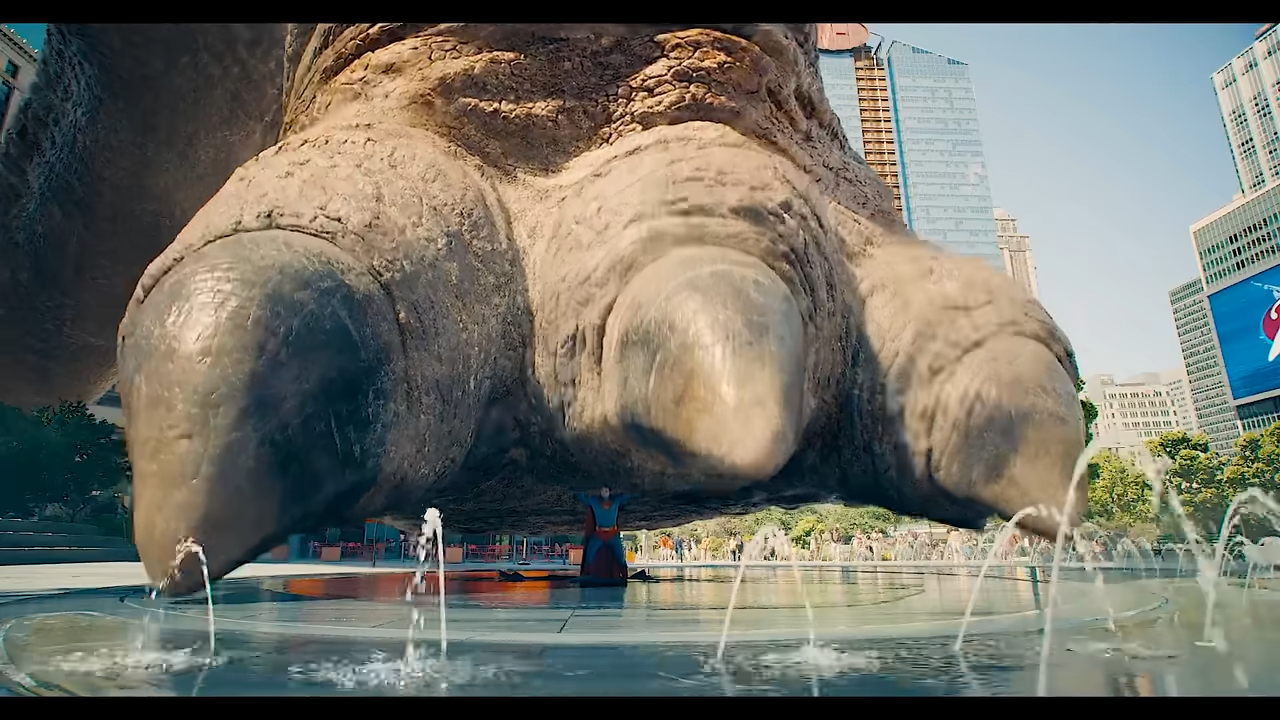
The Kaiju in Superman has pretty thick legs (and big feets that need a pedi ASAP). Superman (2025) trailer © DC Studios / Warner Bros. Used under fair use
And remember, that’s the thickness of the legs for standing on all four. If our double doggo wants to stand on two legs, now that’s 80 kg of mass spread over two legs, so 40 kg per leg. A quick check of the math, and we’re now looking at legs that have to be 8.03 cm in diameter, or otherwise, they’d break from the stress load on them.
Oh, and all of this also applies to other structural elements of bodies, including those that are external. Spiders, scorpions and all insects have to obey the cube-square law. Body mass and structure limits will always be partners in a well-choreographed dance.
No dog-sized spiders are allowed on Earth.
Thicc Legs Were Just the Start
A few more issues to quickly consider that are all related to the bigger picture:
- Energy: As that volume increases by the cube, its energy demands are also going to increase…by the cube. Big, big animals need to eat a lot to keep their fires burning. There are all kinds of environmental implications with this. An enormous Kaiju has the potential to decimate populations of prey and find itself really hungry.
Food is eaten, chemical bonds broken, and energy released that the animal can use. On our scale, with our metabolism, it’s what gives us our 98-ish oF body temperature. - Heat: Animals get rid of heat through their skin, or whatever surface is in contact with the air or water around them. The surface area of the skin increases by the square, but the stuff inside — the stuff making the heat — that increases by the cube. An animal’s metabolism is responsible for the heat on the inside, and the inside increases by the cube. So, apply that to animals big and small.
The smaller the animal, the faster it will lose heat, therefore the faster its “engine” is running. Mice have seriously fast heart rates. Additionally, mice must eat constantly to maintain their metabolism. On the other hand, an elephant has a slower metabolism, loses its heat slowly; therefore, it doesn’t have to eat as often, and moves on the whole, slower than smaller animals (though they can move fast when needed).
Following our rules (as we understand life), Kaiju, given their huge size, would rarely eat, move very slowly, and have a serious problem with heat, due to their large volume. They’d need some mechanism for getting rid of that excess heat, whether it’s radiators (fins, fans) or, now and again, blowing off jets of plasma.
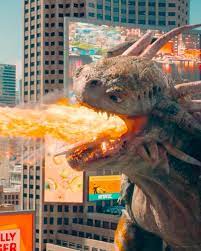
It may not be mean, it may just need to get rid of heat… Superman (2025) trailer © DC Studios / Warner Bros. Used under fair use
- Movement: Mentioned above, the larger the animal, the slower the movement. Movement takes muscles, and remember, muscles scale up by the square, not the cube. Physically, a larger animal has less muscular force per mass than a smaller animal does.
Thanks to that, it’s more difficult for a large animal to start, stop, or redirect any motion. The force provided by muscles in smaller animals just isn’t there for larger ones. Throw in things like momentum and inertia, and Kaiju on the whole would have a much harder time throwing (and stopping that swinging arm) a punch than a smaller animal. Again — force to start the motion and to stop the motion. - Cells: That volume of the larger animal that increases by the cube? That volume is made up of cells, fluids, and living creature stuff, but let’s focus on cells. Cells are where the metabolism happens — that’s the unit that creates the heat, needs the food, and all the rest of the living stuff. Cells need oxygen — it’s why we breathe, and other organisms have figured out their own methods of getting the gas into their inner workings.
Oxygen diffuses into cells from the blood (or whatever is carrying it through the body) – the bigger the cell, the longer it takes for the oxygen to get to the good stuff — cellular respiration. For small animals, this pathway is short, and the delivery can be quick. The larger the animal, the longer the path, and the more complex the circulatory system. Paths have limits on their lengths — too long, and the oxygen can’t reach the parts of the cell efficiently. And also, the larger you are, the bigger and stronger the pump you need to move that blood through the body without it stalling out.
Kaiju — without invoking magic, this is another dealbreaker. There are ways around this that can be imagined, such as smaller cells, a more complex circulatory system, multiple hearts, or membranes to extract oxygen from the atmosphere… All plausible in their own way, but each adaptation to provide for the Kaiju’s system takes energy to build and maintain. More energy to maintain, higher metabolism.
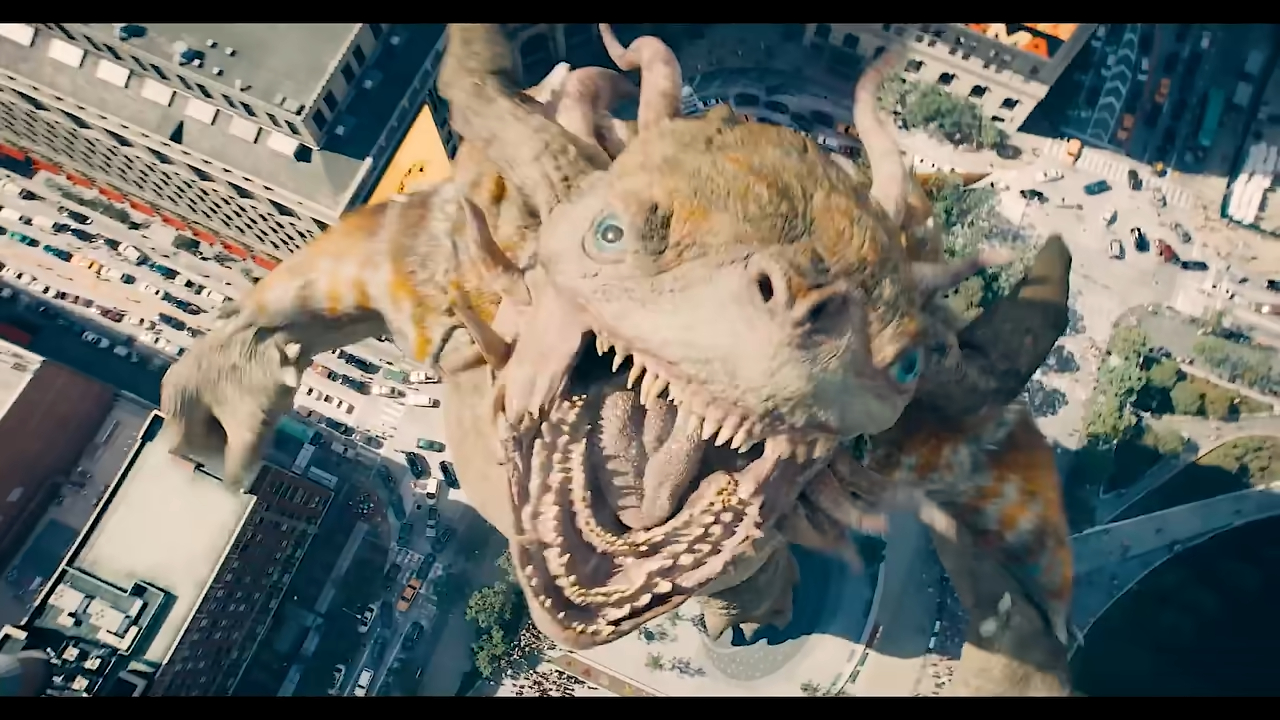
Just hangry for a Big Belly Burger? Superman (2025) trailer © DC Studios / Warner Bros. Used under fair use
- Food: Been talking about metabolism and energy — larger animals need more energy, and we all get energy from food. Small animals with fast metabolisms eat constantly to replace the energy as its used up (and have relatively small poops per capita). Larger animals flip that – they eat less (but a lot of them’re vegetarians — grasses and feed vegetables have less energy than meat) because their slower metabolism allows for it. They also have relatively larger poops per capita. And given the size of stocks of what Kaiju would consider food, they would decimate entire regions of large animals, leaving only the small ones that could easily hide and quickly run away.
Kaiju — as shown historically (and in the trailer), tend to move quickly given their size. That would be supported by a faster metabolism (gas exchange, and heat considerations too) that would require a lot of energy to support it. A lot. And Kaiju would have, per monster, epic poops.
Our “Kaiju”
Yes, we do have some big animals on Earth, but nothing approaching Superman’s Kaiju, Godzilla, Kong, or any of the others that hit screens. Unfortunately (shakes fist at universe), our earthly kaiju have to follow the cube-square law.
Our own “kaiju” are worth a look, largely because we have three distinctive environments: air, land, and water. The main player in how big our kaiju in these environments can grow is an oldie but a goodie — gravity.
Gravity determines weight. So while mass (the “stuff” inside a thing, molecules and atoms) doesn’t change, weight does. Less gravity, less weight. More gravity, more weight.
“Living” in the air gives a little help against gravity — wings can help provide lift, and lighter structures than land animals (birds’ hollow bones, for example) can assist with a size boost, but when birds land, they’ve got the same problems with mass that land animals do. So let’s just consider two environments: land and water.
On land, the current champion is the African bush elephant, weighing approximately 6,000 kg. It matches everything you’d think — slow, thick legs, low metabolism, eating infrequently (but as a vegetarian, eating a lot). We’ve had bigger, like the Argentinosaurus, which probably topped off at 100 metric tons (100,000 kg), but we’re unlikely to see anything that big again.

Our Kaiju can manage the sufficient skeletal structure and metabolism that Argentinosaurus must have had, but the giant dinosaur had a couple of other factors going for it — a stable food supply (lush forests and grasses), and a stable environment (both in terms of climate and predators). Given Earth’s gravity and environmental/climatic conditions, most researchers feel that the 100 metric tons of Argentinosaurus is at the practical limit for land creatures on Earth.
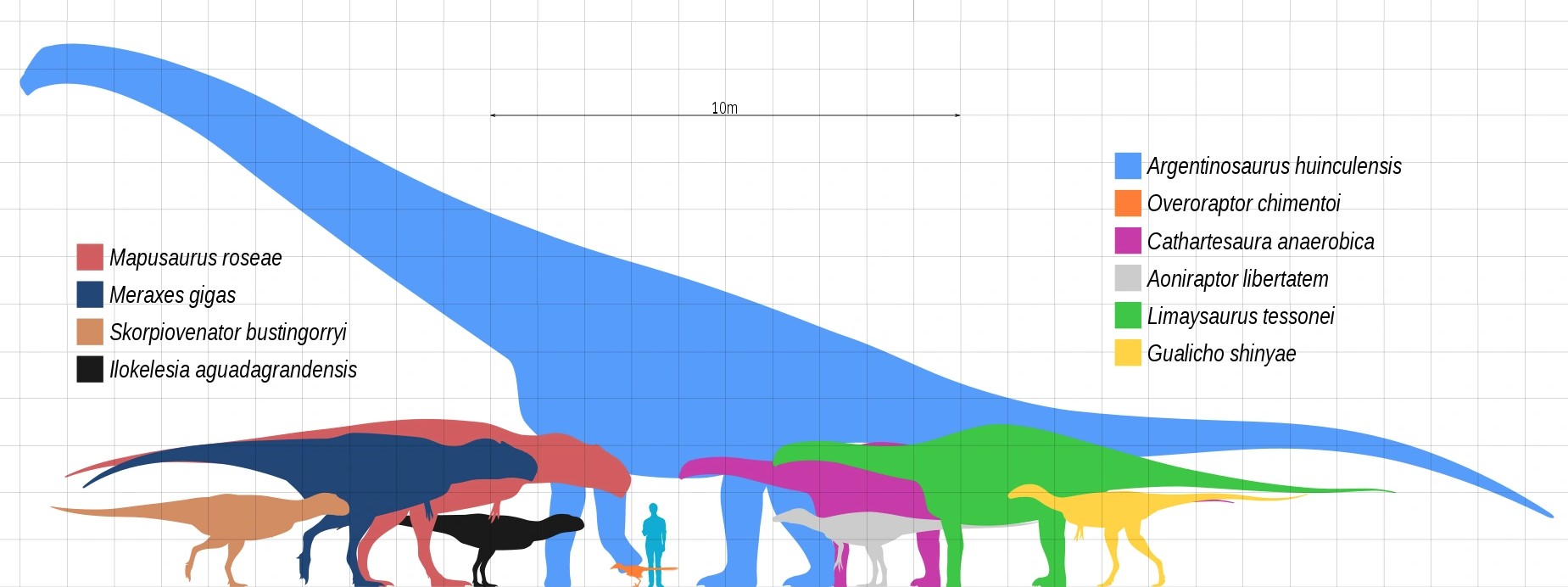
Argentinosaurus was big. Not just big. But BIG big. by Slate_Weasel Wikimedia Commons, used under CC BY 4.0
Jump into the ocean and float. A body’s buoyancy reduces the effects of gravity, so the water can allow larger animals to develop. The current champion is the Blue Whale, weighing approximately 200,000 kg. Water does help. As far as we know, there’s never been a challenger to the blue whale’s title as the biggest, although, to be fair, monstrous marine dinosaurs could have existed, but they tend to sink when they die.
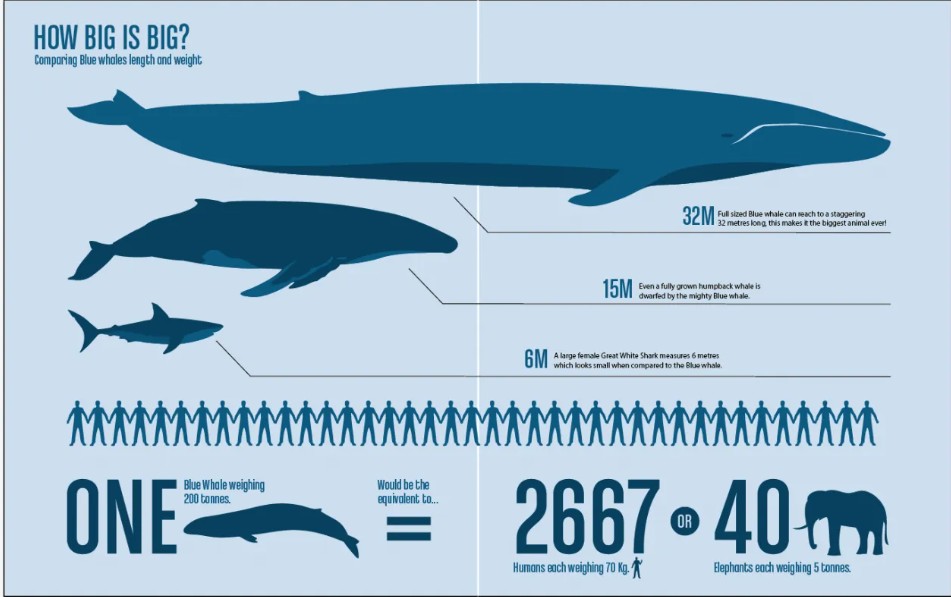
It’s hard to grasp the size of blue whales — even with comparisons. Image (c)Orca Ireland
But the blue whale is strictly limited to the water. If one wanted to come up against the African bush elephant on land, it would immediately realize its mistake. Without the structural support of a skeleton made for living on land, the whale’s mass would crush it.
But…But…But
I get you — the “what about if…”s. Yeah — what if it was nuclear powered (looking at you, Godzilla), uses stronger stuff in its skeleton, has radiant fins on its back to get rid of heat, or has some other exotic biology that allowed it to grow to a massive size that we just don’t know about. All fine options…
in fiction. In our world, we’re stuck — the cube-square law wins the day.
But we can keep hope alive. Real Kaiju would be cool. Terrifying, but cool.
Advertisement